Below are the notes for a session I helped deliver to my parish’s young adult community in May 2025. It explored the social doctrine of the Catholic Church in light of our newly elected Pope’s chosen name, Leo XIV. In hindsight, I dwelled far too long on historical details, at the expense of a more thorough discussion on the practical applications of Catholic Social Teaching in the world today. Nonetheless, preparing for the session was a edifying experience that exposed me more deeply to this oft-overlooked treasure of the Church’s intellectual tradition, and I would like to continue sharing it with others in any way that I can. I have inserted relevant screenshots of the slides that accompanied the presentation, where appropriate.
On Earth as it is in Heaven: An Introduction to Catholic Social Teaching (24 May 2025)
Habemus Papam! At the start of this month of May, our Church was blessed with the election of Cardinal Robert Francis Prevost as the successor of St. Peter – our 267th Pope. He was relatively unknown compared to the other “frontrunners” like Cardinal Tagle from the Philippines, or Cardinal Parolin from Italy. But it seems like the Holy Spirit once again had other plans, and our Church was blessed with another Pope from the Americas.
He is American by birth, from the south side of Chicago, but Cardinal Prevost spent most of his priestly ministry as an Augustinian missionary in Peru. Philip and Emily shared with us last week about our new Pope’s spiritual father, St. Augustine, and the Augustinian spirituality that has been such a rich and fruitful patrimony of our Church. And so, on my small part, I wanted to continue that theme of exploring different aspects of our new Pope’s personality, and in today’s sharing expound slightly on his choice of papal name, Leo XIV.
What’s in a name?
The very first decision – or maybe the second, as he must first accept the Conclave’s decision – a man makes after being elected Pope is the name he adopts. It is a distinct and decisive feature of their personality and the vision of their ministry as the Vicar of Christ on earth. Cardinal Jorge Bergoglio chose to be Pope Francis, after St. Francis of Assisi’s example of love for the poor and marginalised. Cardinal Joseph Ratzinger became Pope Benedict, on one hand acknowledging the great patron Saint of monks and of Europe; on the other a tribute to his predecessor Benedict XV who led the Church through the trials of World War I. So, it is significant that Cardinal Prevost has decided on the name Leo, and we should ask ourselves what it means.
Thankfully, Pope Leo has already offered his reasons. In his first address to his brother cardinals, he explained that Leo XIV takes reference from Leo XIII, who was Pope from 1878 to 1903. Specifically, he takes reference from Leo XIII as the Pope who wrote a letter to the bishops called Rerum novarum – in English that means “new things”. This is an apt name because Rerum novarum was a letter – aka encyclical – which laid out the Catholic Church’s position on various social issues that began to emerge in a new and changing world.
At the time when Rerum novarum was written (1891) the effects of the industrial revolution were really beginning to show: not just the fruits of innovation and technology, but also the social ills which it generated and helped to perpetuate in rapidly industrialising and urbanising cities, such as those regarding workers’ rights, property rights, the dignity of labour, et cetera. Rerum novarum was important because it confronted those issues with firm Christian principles, promulgating the Church’s stance to the bishops officially, but in effect also to the whole world. Because of that, Rerum novarum is considered to have laid down the modern foundations of this thing called “Catholic Social Teaching”.
In his choice of regnal name, we see that Leo XIV picks up immediately on this project. He calls Catholic Social Teaching the Church’s “treasury” which must be again renewed and offered to the world, a world which is once again on the cusp of an alarming revolution in digital technology and artificial intelligence. These issues clearly have a deep resonance for Pope Leo, who continues to speak at length about the Church’s role to confront this disturbing reality, and provide an alternative approach to the path taken by the world. And here, following his predecessor Pope Leo XIII, Catholic Social Teaching will form a central part of the Church’s vanguard effort to tackle these urgent questions. It is to this topic that we turn for the rest of today’s session.
Points of departure
We should spend some time considering what the broad term “Catholic Social Teaching” really entails. It comes in a few names – Catholic Social Teaching, Catholic Social Doctrine, Catholic Social Thought – but they all point to the same thing.
I think the point of departure for Catholic Social Teaching is the simple but also profound observation that man, as man, is an inherently social being, and finds the numerous fixtures of his life defined by the unavoidable fact that he lives in society. I’ve included this beautiful painting by Renoir that tries to capture the dynamism and texture of this reality – we eat, dance, laugh, and converse together, always open to building relationships with others. But precisely because the textures of these relationships are so rich and varied, we categorise them into different dimensions of man’s social life. These may be political, economic, or cultural in nature, and we all participate in these spheres in different ways, taking into account our unique vocation and particular stage of life.
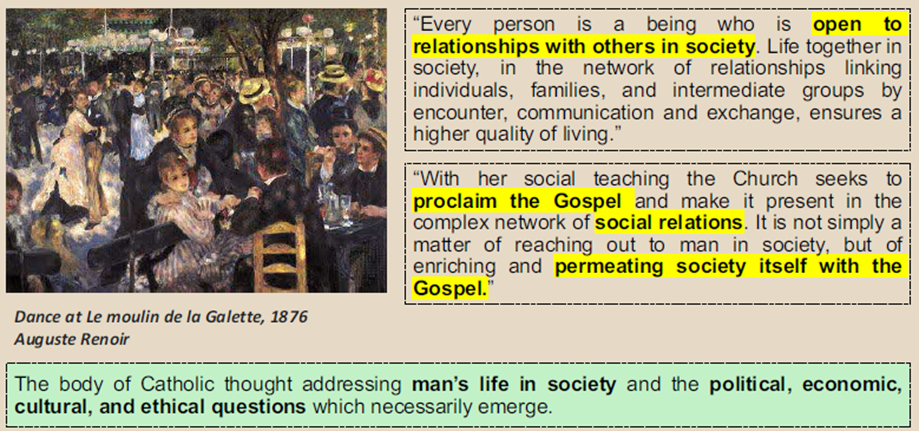
Now, the Church recognises this basic fact of man. And bearing in mind always the Church’s mission to spread the Gospel to the ends of the earth, we can see that Catholic Social Teaching is simply the way the Church directs this evangelical impulse towards man’s social relations, the institutions which mediate and embody those relations, and the questions about such relations that arise.
One of the quotes I’ve included in this slide sums it up nicely – social teaching seeks to “enrich and permeate society itself with the Gospel”. So as a basic starting point I think we can think of Catholic Social Teaching like this: it is the Church’s body of thought addressing man’s life in society and the political, economic, and ethical questions which necessarily emerge. There isn’t really a “fixed” definition of Catholic Social Teaching, so this is kind of my own preliminary synthesis.
It is becoming increasingly clear that this is an incredibly broad category of topics and issues, ranging from subjects like nuclear non-proliferation, to immigration, and to the environment. It would be truly impossible to do justice to the full breadth of ground covered in this sharing. What the Faith in Practice team had in mind really was to give a high-level overview of Catholic Social Teaching – its foundations, its historical genesis, some of the key texts/resources, and why they matter to us today.
Why it matters
It might be helpful to start with “why it matters”. Although it may appear self-evident, I think it is worth reflecting on some of the key mysteries of our faith that render social issues so important in the mind of the Church. After all, many secular institutions and philosophies promote a similar deep engagement with the various social issues of the day, so it is useful to mark out what forms the distinctly Christian character of our own concerns.
I think this is of such great importance to the Church because our faith is deeply incarnational in nature. As Philip and Emily touched on last week, the Christian faith is one which affirms without hesitation the essential goodness of creation – of this earthly world. It is quite unlike other systems of belief which would disavow the flesh, the embodied, and advocate instead for a flight from this reality, from concrete being.
There are many reasons why we believe this as Christians – Genesis says that from the very beginning God looked upon creation and “saw that it was good” – but I think that conviction is hinged most of all upon the mystery of the Incarnation. Because the Word was made flesh and lived among us; because Christ Jesus emptied himself to be born in human likeness; it was because God became man that the true value and worth of creation was validated in a wholly unequivocal way.
Paragraph 22 of Gaudium et spes, an important document of the Second Vatican Council, spells this out rather pithily: “Christ, the final Adam, fully reveals man to himself”, and through his taking on of human nature, “raises it up to a divine dignity”. This was not accomplished in some abstract way. Christ was a human being in the fullest sense, embracing all of the social realities that accompanies the life of man. And so, it can be reasonably said that we care about man’s life in society because so did God – he cared about it so much that he entered totally into it, showing us its true reach and the full extent of its possibilities.
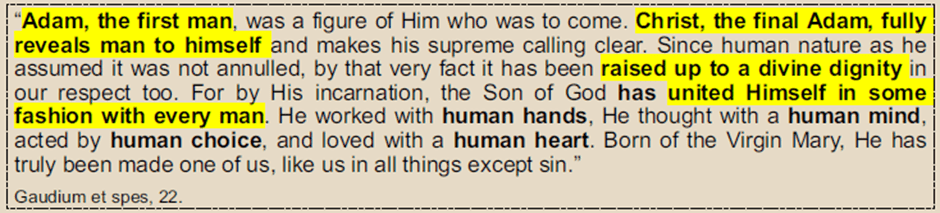
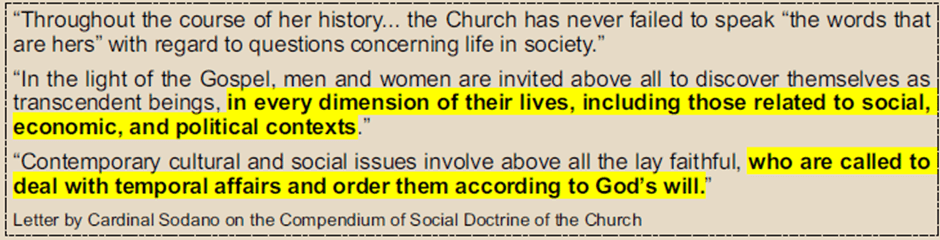
It is from this affirmation of the life of man, of man caught up in society and the relationships found therein, that the Church derives the basis of her social teaching. The Church prompts us all to invite the Gospel into the political, economic, and social dimensions of our lives, that enlivened by the word of God, we as lay people may “deal with such temporal affairs and order them according to his will.” To that end, Catholic Social Teaching serves to inform our consciences, mature our understanding, and provide guidance for our behaviour, that we may conduct our lives according to Jesus’ appeal in the Lord’s prayer: on earth, as it is in heaven.
Deep roots
Now that we have some sense of what CST is all about, I think it would be helpful to take a “birds-eye view” of its foundations and history as a whole. Although the terms such as “social teaching” or “social doctrine” of the Church (which signify a certain unity in this corpus of thought) have their lexical origins only at the beginning of the 20th century, the substantive content of this teaching arises from sources way older than that. This slide tries to depict some kind of broad (but necessarily limited) schematic representation of what we might consider “sources” of CST through the Church’s history.
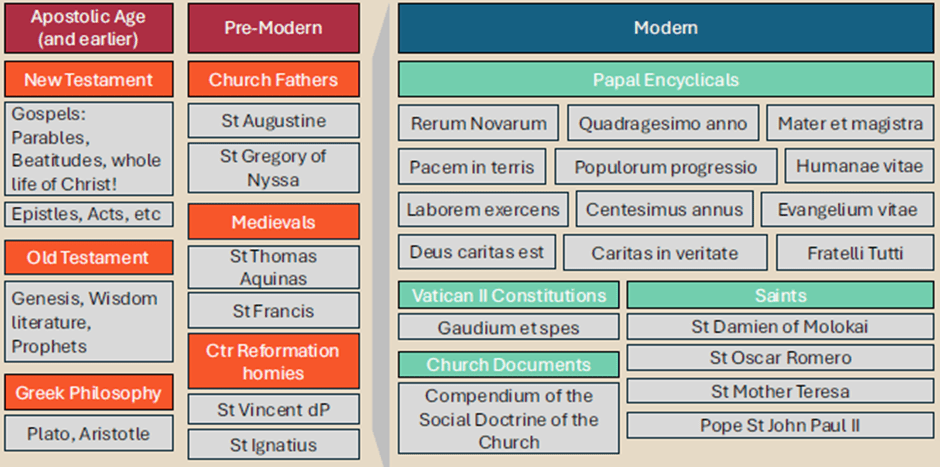
As we discussed earlier, the absolute basis of these teachings are certain fundamental truths about God and man, which have been revealed to us through God’s salvific action in history. So, as a start, we can look to the Old and New Testaments, the word of God as it was revealed through the written form.
In the Old Testament we have Genesis and the rest of the Pentateuch – the story of creation, of Adam made in God’s image, the ten commandments, the precepts of Israelite social organisation and life – but also the profound lessons that emerge from the Wisdom literature and the prophets, among so many others.
In the New Testament, one immediately recalls the teachings of Christ in the Gospels – the parables, so many of which are highly sensitive to the demands of social justice, the Sermon of the Mount, which tells us about the blessedness of “the poor in spirit”, and indeed the entire life of Christ as man par excellence. But the writings of Paul in his letters, or Epistles, also concern themselves with social issues, especially as he expounds on the role of Christians in a hostile, “pagan” world, and the obligations they had while living in community. We can see from this that CST really has deep and ancient roots, which speaks also to the perpetual relevance and urgency of its message.
One thing I want to add is that other non-Jewish, non-Christian philosophies also had some influence on the Church’s social thought. It is no secret that the Church, in constant dialogue with the best ideas offered by the world, draws from and purifies these intellectual moments, that they may offer their own unique contributions at the service of the Gospel. For example, Greek ideas of natural law, justice, and man’s role in politics have been quite influential on certain aspects of Catholic social thought. I think this highlights a theme that surfaces quite frequently during Harbour sessions, this idea that “faith and reason” are in no way at odds with each other, each complementing the other to assist man in his search for truth.
As we move from the apostolic age into the “pre-modern” column, we continue to encounter familiar names in the Church’s tradition. The Church Father St. Augustine, who we’ve talked about last session, wrote “The City of God”, which is part history, political philosophy, and theology, and teaches about Christian obligations towards promoting justice and order in society. Of the medieval doctors of the Church, St. Thomas Aquinas’ writings, especially the second part of the Summa Theologiae, have a lot to say about Christian morality and ethics, especially from a moral-theological perspective.
And of course, beyond writings and literature alone we have the wonderful example of great saints that have demonstrated the teaching of the Church in the total conduct of their lives. St. Francis of Assisi and St. Vincent de Paul brought their Mission to the margins of society, putting “real flesh” upon the idea that we must always love and serve the poor. St. Ignatius, on his part, advocated “contemplation in action” – a faith which, ever restless, sought to make itself present to the practical needs of society. All these pre-modern saints were, in their way, champions of the need for justice, charity, and care for the common good.
Modern foundations
Bearing in mind this rich heritage that tradition has passed down to us, we finally get to talk about the modern foundations of Catholic Social Teaching, which as we said in the beginning kind of traces its direct ancestry to Rerum novarum in 1891.
Although we have gone on at great length about how social issues are not a new or modern concern for the Church, and indeed stretch back hundreds of years, Rerum novarum remains a distinct milestone for the Church because it was the first encyclical that explicitly addresses the contemporary social issues of the day, including very practical and real-life issues like the conditions of factory and industrial workers.
This established a new precedent for how the Church responded to the prevailing challenges of each age, because Popes after Leo XIII continued to issue social encyclicals at regular, timely intervals, consistently asserting the Church’s moral authority and rule of charity amidst a rapidly changing world. I’ve listed just a few here; recent ones like Fratelli tutti by Pope Francis and Deus caritas est by Pope Benedict might be familiar.
But beyond the papal encyclicals, CST also finds expression through important documents of the Second Vatican Council, like Gaudium et spes, promulgated in 1965, and official documents published by the Vatican like the Compendium of the Social Doctrine of the Church, which was commissioned by Pope John Paul II in 2003. This compendium really is a marvel. It’s fully available for free online, just like the Catechism, but I was told last week that screens are making us stupider every day, so I went out of my way to buy a hard copy edition. It’s not quite bedside reading, but it is chock-full of good stuff; it basically summarises everything I’ve mentioned so far into a topical, systematic format. Which is so small feat given the absolute breadth of subjects that social teaching entails.
Of course, our learning should never be confined to bookish wisdom alone. The examples of our great 20th-century saints serve as rallying cries to search for the face of Christ amidst the suffering and the least. St. Damien of Molokai devoted his life ministering to leper colonies; St. Oscar Romero was a vocal proponent of human rights against a brutal El Salvadoran military dictatorship; Mother Teresa brought the tenderness and compassion of God to the truly destitute and wretched. And of course, St. Pope John Paul II, “the Great”: not merely an author of deep and profound encyclicals on human dignity, but a man who characterised that love for humanity in his mission to evangelise the world.
But because we are running out of time, as we dive a bit deeper into CST I will focus on just a few titles on the page: the social encyclicals Rerum novarum, Pacem in terris, Laborem exercens, Deus caritas est, Caritas in veritate, and Fratelli tutti; Gaudium et spes from the Second Vatican Council; and the Compendium.
A Church in history, for history
As we recalled earlier, our Christian faith is especially unique because of its radical concern for history. It is in and through history that we see the light of the Gospel radiating towards all the peoples of this earth. From its Jewish roots – indeed, from a marginal Jew, Jesus of Nazareth – the Good News was spread from Palestinian soil to the entire Greek-speaking world, and soon to peoples of every language, culture, and race. The Church has been from its very birth “bound up” with the unfolding of history through the ages.
It would be a fatal mistake here to assume that the Church was a passive entity in that process, as if it were some archaic institution floating along the currents of upheaval and revolutionary change. No – the Church has always seen it as her mission to be an agent of history. Christ’s divine commission simply does not allow for the alternative. What I’ve done here is situate some key documents of the church alongside other significant events in a broader historical timeline, to show just how the Church has recognised its duty of “scrutinising the sign of the times” and responding to the “perennial questions” which men ask tirelessly.
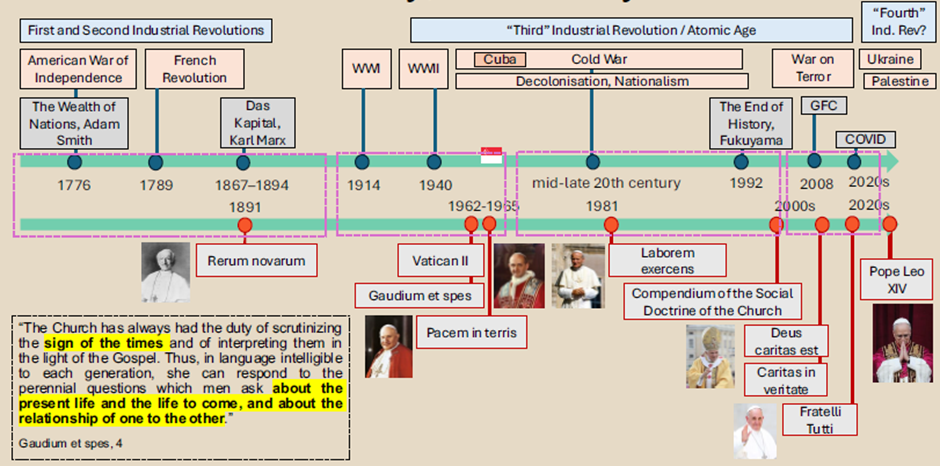
It turns out that a lot of those perennial questions are practical ones, concerned about the way people should behave, organise themselves, and treat one another in society. For instance, we see that Rerum novarum, published in 1891, spoke up against two opposing ideological poles that fought over how man should best work and live: the system of communism on one hand, and on the other, unregulated laisse-faire capitalism. This was amidst the rapid industrial changes that upended labour conditions in both America and Europe, and the accompanying revolutionary moment that swept across the Old Continent. There was a need to speak difficult but eternal truths to the world; Pope Leo XIII, guided by the Spirit, made sure the Church shone like a beacon amidst this confusion, sent always to illuminate the conscience of the world.
Pope Leo XIII’s successors did the same. We won’t exhaust ourselves with 100-plus years of history, but Pacem in terris by Pope John XXIII in 1963 is worth considering. Pacem in terris, or “Peace on earth” in English, was written in the years after WWII, a moment of both optimism and uncertainty. It was in these years when international organisations like the UN were founded, and many colonial states achieved independence from their European metropoles. But it was also a time where the existential threat of great power conflict and nuclear war loomed interminably as a concern.
All this must have been on John XXIII’s mind when he wrote his encyclical, which speaks about the rights of man in relation to the state, the community of nations in cooperation with a world authority, and above all, a call for peace and unity in a world increasingly divided into East and West.
In their unique way, every Pope since has similarly “spoken truth to the world” according to the needs of that day. Through their Petrine ministry, and spurred on by the zeal of the Spirit, they show that the Gospel is truly “ever ancient, ever new”; it must always be sown afresh upon men’s hearts to revitalise his activity and aspirations as a subject in society. Pope Leo XIV, at the far right end of the line, is surely called to do the same.
Social teaching: variations on a theme
But the beauty of our Church is this: even though each of our Popes have responded to the particular circumstances of his time, which pose new questions and thus demand unique answers at every stage, there nevertheless exists a strong common thread which weaves all of these teachings together, allowing us to truly call it a “body” of teachings. After all, what is a body if not something that exists as a unity, in harmony and continuity from one part to the next?
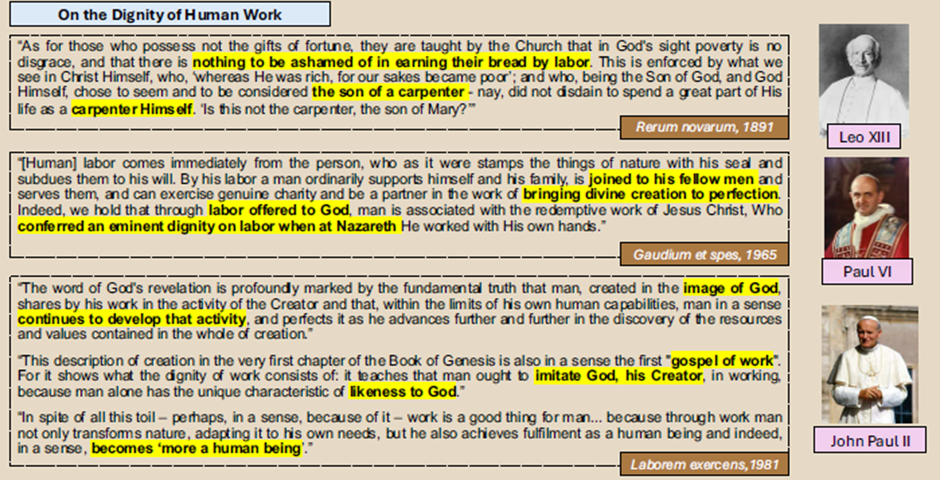
The text boxes we have up here try to give some examples of this. One of the big “themes” of Catholic Social Teaching is the inherent dignity of work. Honest work. We see that each of our Popes and their encyclicals choose to express this fundamental truth in different ways.
Rerum novarum talks about how humble, laborious, work must be considered honourable and good, precisely because of Christ’s own earthly vocation as a carpenter, a worker.
Gaudium et spes, promulgated when Paul VI was Pope, elaborates on that point by explaining how labour, when done in the right spirit and offered freely up to God, is a way that man participates in the redemptive sacrifice made by Jesus himself. Work, done in charity and done for his loved ones and fellow men, is affirmed as an authentic path to holiness.
Finally, John Paul II’s Laborem exercens makes even clearer that this was not merely an “afterthought” of God that became true because of the Incarnation – no, truth is eternal. Drawing from the very first pages of holy scripture, he shows us that work has always been an essential dimension of man’s creative personality, a “gift” that flows from our nature as spiritual sons and daughters of the Father. And it is through our commitment to work that we acknowledge and develop this personality, modelled after the divine.
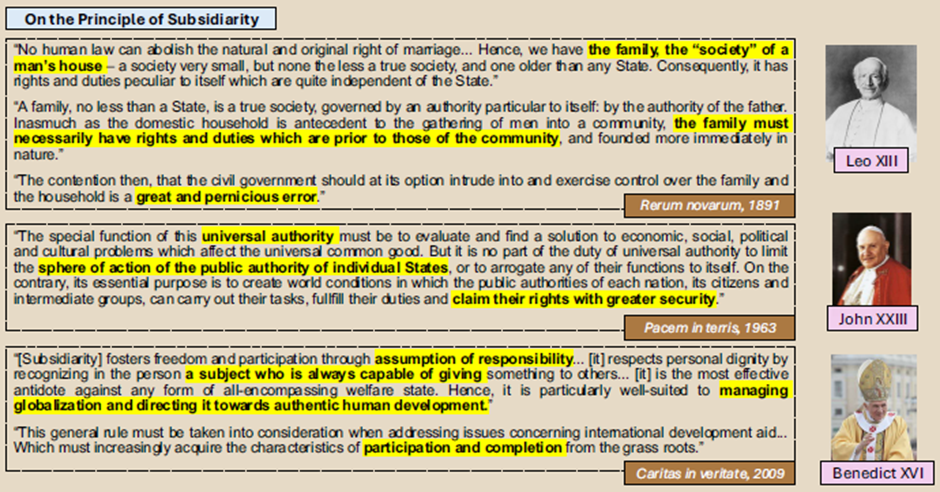
We can say the same for the Principle of Subsidiarity, which is basically the idea that matters should be handled by the smallest, or least centralised authority, rather than being taken over by a higher or more distant organisation. This means decisions should be made as close as possible to those affected, with higher authorities only stepping in when local efforts prove insufficient.
A very silly but clear example of this would be what kind of breakfast your kids eat. Sure, it’s debatable whether granola or fruit, or eggs and ham etc. is actually the best or healthiest choice, but most folks probably agree that these should be decisions made by the family and not the state. Different social encyclicals explore this principle from different angles, and with unique contemporary concerns in view.
Rerum novarum emphasises the rights and duties of the family, which is the smallest and most fundamental building block of society after the mere individual. These rights are addressed to itself, its own sphere of activity and influence, are not something that higher organisations or authorities like the state should infringe upon.
Pacem in terris by Pope John XXIII applies that same principle to the emerging international organisations that are established in the mid-20th century. Even though we affirm the importance and even necessity of world authorities, there is a limit to their reach, which should never hamper the ability of sovereign states to assume true responsibility and direction over their destinies.
Pope Benedict XVI’s Caritas in veritate builds on this further, criticising the failure of international aid projects that approach humanitarian efforts from an overly paternalistic standpoint. He stresses the need to encourage “authentic human development”. We care so much about metrics like GDP, HDI, et cetera, but often at the expense of a holistic appraisal of what it means for humans to flourish according to their nature. That is, as subjects called to be active participants in the unfolding of their lives and the lives of others, to give as they also receive.
Conclusion
We don’t have time to treat all of the different principles of Catholic Social Teaching thoroughly, so you’ll have to forgive how brief I’ve been. I think our main idea was to show why Catholic Social Teaching matters, and how it develops and matures over time while always remaining faithful to its core precepts and principles.
Of course, that is simply to say that it remains true to its ultimate foundations in the words and deeds of Christ. And because of these foundations, this veritable “treasury” of the Church continues to be a reliable guide as we negotiate the challenges of the world with faith, hope, and love – yesterday, today, and until He comes again.
Reflection
- What are some ways that the Gospel “permeates” the different roles and responsibilities you take on in life?
- What are the social issues that disturb or challenge you the most today? How could the Church’s teaching help you confront these difficult realities?
- Pope Leo XIV asks us to build a “missionary Church that opens its arms to the world”. How could we heed the Holy Father’s call in the activities of our daily lives?


Leave a comment